


History of Mali Lošinj: From Maritime Power to Island of Vitality

Could a single breath of salt-laden air transform a humble 13th-century fishing village into Europe's most sophisticated wellness sanctuary? You've likely felt that immediate, aromatic shift when stepping onto our sun-drenched shores, sensing that this island offers more than just a typical Adriatic escape. Understanding the history of Mali Lošinj reveals a narrative far richer than simple dates on a map. It's an evocative story of resilience that bridges the gap between rugged maritime power and the refined, nature-centric tranquility we offer today.
We promise to show you how Lošinj evolved from a 19th-century maritime titan with a fleet of 150 sailing ships into the world-renowned Island of Vitality we cherish in 2026. You'll skip the academic jargon and gain clear context for the landmarks you see from your luxury tent. We'll preview the golden age of seafaring, the botanical legacy of the Čikat Forest, and the specific historical sites that will anchor your stay in our pristine Mediterranean paradise.

Key Takeaways
Trace the mythical origins of the Apsyrtides and the 13th-century arrival of the pioneering families who founded the island's first permanent settlements.
Explore the rich maritime history of Mali Lošinj to understand how this Adriatic gem evolved from a shipping powerhouse into a global wellness sanctuary.
Discover the 19th-century scientific breakthroughs that led to the island's official 1892 designation as a premier European climate health resort.
Learn how the protected Aleppo pines of Čikat Forest Park serve as "green lungs," preserving the island’s heritage through modern, eco-conscious hospitality.
See how contemporary glamping honors the island’s legacy, blending refined luxury with the healing scents of sea salt and pristine Mediterranean nature.
Table of Contents Ancient Roots and the Maritime Golden Age of Mali Lošinj The 19th-Century Shift to the 'Island of Vitality' Preserving Lošinj’s Heritage through Modern Glamping
Ancient Roots and the Maritime Golden Age of Mali Lošinj
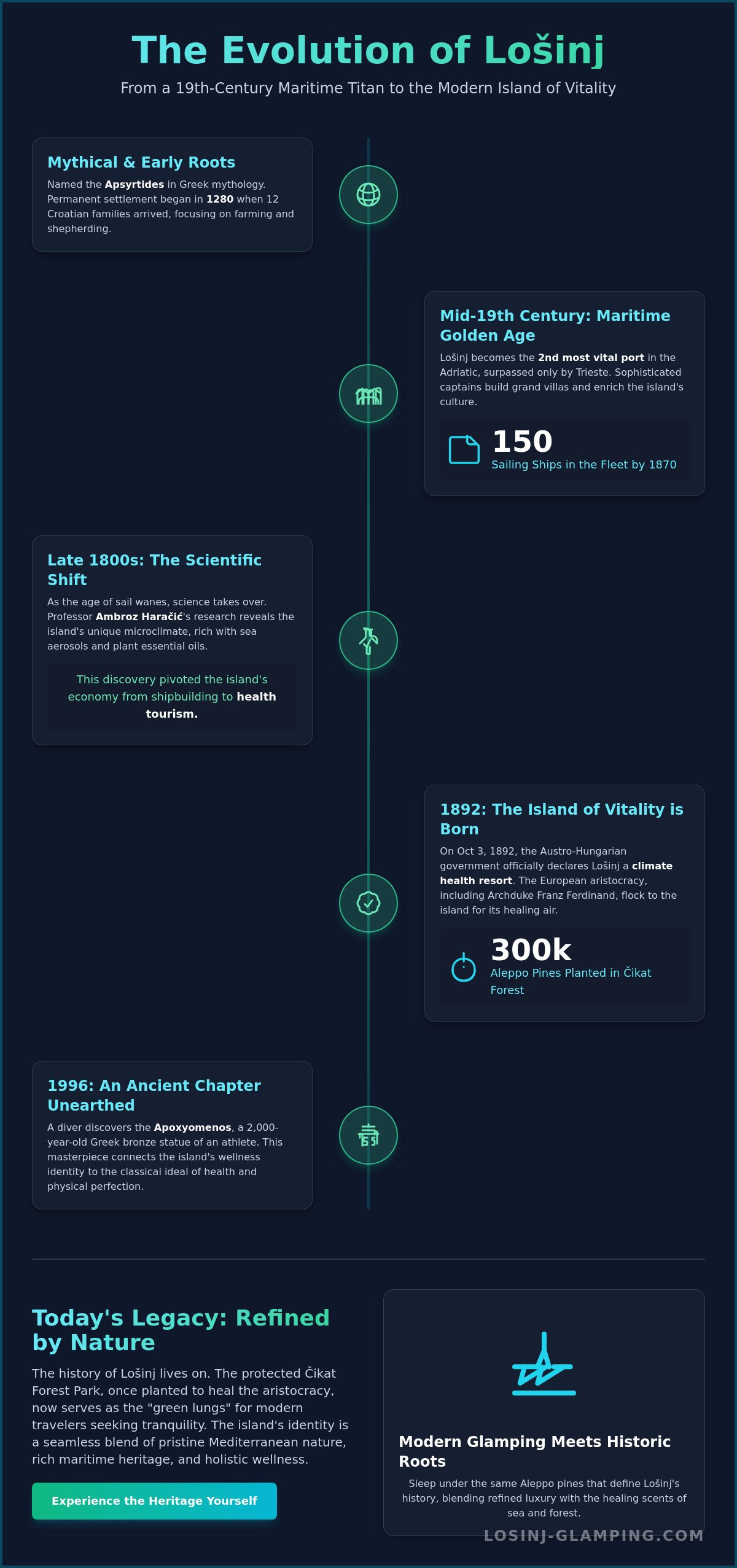
The story begins in Greek mythology. Legend names these islands the Apsyrtides, born from the fallen limbs of Apsyrtus. This ancient identity still lingers in the salt-misted air and the rhythmic lap of azure waves against the shore. Permanent settlement solidified in 1280 when 12 Croatian families arrived, establishing roots in the fertile interior of the island. Initially, life revolved around sheep farming and agriculture, yet the sea eventually called to the islanders.
By the 18th century, a dramatic shift occurred. The community moved from the hillsides to the harbor, transforming a quiet island into a dominant maritime state. The History of Mali Lošinj reached its zenith in the mid-19th century. During this era, the town became the second most vital port in the Adriatic, surpassed only by Trieste. Local shipyards hummed with constant activity, launching massive wooden vessels that traversed the globe and brought wealth to these sun-drenched shores.
The Rise of the Lošinj Captains
Wealth flowed with the tides. By 1870, a fleet of 150 sailing ships belonged to the island's elite. These Lošinj captains were sophisticated cultural ambassadors. They returned from distant voyages with exotic plants and architectural grandeur, a legacy visible today in the Fritzi Palace. This maritime success fueled the town's architectural wealth, creating an atmosphere where rugged sea life met refined European sophistication. It's a heritage of excellence that defines our island's unique character.
Venetian and Austrian Influences
Strategic location brought both prosperity and peril. In 1445, the Venetians built the iconic defensive tower in Veli Lošinj to guard against Uskok pirate raids. This stone sentinel protected the community and its growing wealth. Later, Austrian influence refined the island's infrastructure, turning it into a sanctuary for the elite. Explore these stone monuments and see how to reach these historical sites in our 2026 travel guide to the Island of Vitality. The blend of Venetian defense and Austrian order shaped the history of Mali Lošinj into the tranquil paradise we invite you to experience today.
The 19th-Century Shift to the 'Island of Vitality'
By the late 1800s, the maritime industry slowed; science took its place. Professor Ambroz Haračić began meticulously mapping the island's microclimate in 1880. His years of research revealed an extraordinary environment. The air was remarkably pure, saturated with sea aerosols and plant essential oils. This scientific foundation fundamentally altered the history of Mali Lošinj, pivoting the economy from shipbuilding to health tourism.
The 1892 Decree: The Austro-Hungarian government officially declared Mali Lošinj a climate health resort on October 3, 1892.
Forestation of Čikat: Haračić spearheaded the planting of 300,000 Aleppo pines. This massive project transformed the rocky landscape into a lush, green lung.
Imperial Favor: Austrian Archduke Franz Ferdinand visited for winter recovery, bringing the European aristocracy with him.
The scent of the sea salt mixed with pine needles became the island's signature. This unique olfactory profile helped establish Lošinj as the Island of Vitality. It wasn't just a destination; it was a medical prescription. The 19th-century elite built grand villas among the pines, seeking the "healing breath" of the Adriatic.
The Discovery of the Apoxyomenos
In 1996, the history of Mali Lošinj gained an ancient chapter. A Belgian diver discovered a Greek bronze statue of an athlete on the seabed near the islet of Orjule. The 2,000-year-old Apoxyomenos represents the classical ideal of health and physical form. It serves as a spiritual bridge between the island's ancient past and its modern identity as a sanctuary for physical restoration.
A Haven for Family Wellness
The island's legacy has transitioned from rigid medical sanatoriums to holistic family retreats. Modern travelers seek the same rejuvenation once reserved for emperors. You can easily plan your heritage-filled family holiday in Lošinj to experience this healing air. For those wanting a direct connection to nature, our safari-tents offer a refined way to sleep under the very pines Haračić planted over a century ago.
Preserving Lošinj’s Heritage through Modern Glamping
The Čikat Forest Park remains the essential green lungs of the island. It's a protected heritage site. This lush expanse results from visionaries like Professor Ambroz Haračić. In the late 1880s, he spearheaded the planting of thousands of Aleppo pines. By 1892, the Austro-Hungarian government officially declared the island a climatic health resort. Understanding the History of Mali Lošinj reveals a deep commitment to wellness. Modern glamping continues this tradition by integrating luxury into these historical "Wild" zones without disturbing the soil.
Sustainability meets heritage in the salt-misted air. You'll breathe the same aromatic scents prescribed by 19th-century physicians. This sensory history provides a direct link to the island's past. We balance modern comfort with a rugged maritime spirit. It's a delicate dance between high-end exclusivity and environmental stewardship. Every stay supports the preservation of this unique microclimate. Azure waters and pristine woods stay protected.
Living Among the Aleppo Pines
Our luxury safari tents are designed for minimal impact. They sit on elevated platforms to protect the forest floor and local biodiversity. This architecture respects the intricate history of Mali Lošinj and its natural evolution. You'll wake to the scent of resin and sea salt. It's a sanctuary where nature remains the protagonist. Privacy and peace define the experience. We've created a space where high-end living leaves no footprint.
Your Place in Lošinj's Continuing Story
Choosing nature-centric accommodation aligns with the island's long-standing Vitality mission. It's about rejuvenation and reconnection. You aren't just a visitor; you're part of a legacy that values health and harmony. Our commitment to eco-friendly sophistication ensures the island stays sun-drenched and vibrant for future generations. Join the legacy of rejuvenation. Book your Lošinj Glamping experience and become part of our story.
Step Into the Living Legacy of Čikat
The history of Mali Lošinj moved from a 19th-century maritime peak to a world-class health sanctuary, officially recognized by the 1892 decree declaring it a climate resort. This legacy thrives within the 300 hectares of Čikat Forest Park, a coastal gem established by Ambroz Haračić in 1886. You can still experience the same healing microclimate that once drew European nobility to these shores. Our retreat honors this tradition by providing eco-friendly luxury in the park's secluded "Wild" zone. Managed by local experts Vela Ventis, we offer a sophisticated sanctuary where the scent of Aleppo pine meets the sea. It's a space designed for deep rejuvenation, blending safari-inspired comfort with the island's rugged beauty. You don't need to choose between modern amenities and an authentic connection to nature. We invite you to discover the restorative power of the Adriatic in a setting that celebrates its storied past. Your island escape awaits.
Frequently Asked Questions
When was Mali Lošinj first inhabited?
Mali Lošinj was first mentioned in written historical records in 1398 under the name Malo Selo. While the wider island shows traces of Liburnian and Roman presence dating back to 1000 BC, the town itself developed later as a haven for farmers and shepherds. This settlement eventually evolved into the maritime powerhouse central to the history of Mali Lošinj.
Why is Mali Lošinj called the Island of Vitality?
The island earned its title in 1892 when the Austro-Hungarian government officially declared it a climatic health resort. Scientific studies from the late 19th century confirmed that the blend of sea aerosols and 1,200 aromatic plant species creates a natural healing environment. It's a sanctuary where the scent of Aleppo pine and wild herbs promotes physical recovery and restorative peace.
What is the most famous historical artifact in Mali Lošinj?
The Apoxyomenos, a 192-centimeter bronze statue of a Greek athlete, is the island's most famous artifact. A Belgian diver discovered it in 1996 at a depth of 45 meters near the islet of Vele Orjule. Dating back to the 2nd or 1st century BC, it now rests in its own dedicated museum, reflecting the ancient maritime routes of the Adriatic.
Who planted the pine forests in Čikat Bay?
Professor Ambroz Haračić led the afforestation efforts in 1886. He founded the Society for Afforestation and Embellishment, overseeing the planting of 250,000 Aleppo and black pine saplings to transform the barren landscape. These woods are now a central pillar in the history of Mali Lošinj, creating the sun-drenched, fragrant canopy that defines our island's unique olfactory experience.


Comments